The first time I sprinkled the seeds on the rusty wreckage of the bus, I didn’t expect anything. It’s just the step I need to complete a task — covering a certain proportion of the ruins with green. But a few seconds later, a slender vine came out of the iron frame of the car window, and then a tender white flower quietly bloomed on the steering wheel. At that moment, the cold and distant synthesizer sound effect in the background seemed to become warm, as if the ruins themselves let out a long and satisfied sigh. I suddenly realized that what I was holding was not a gardening tool, but a pen to compose a gentle variation for the doomsday scene.
The world of _Cloud Gardens_ begins in a silent ruin. The dumped truck, the broken viaduct, the half-buried vending machine... These are my canvas. The game did not give me any written narrative about the past of this land, the cause of the disaster, and the story of the survivors. History is solidified in the shape, rust color and dumping posture of these objects. My task is not to rebuild them, not to clean them up, but to embrace, wrap, and finally coexist with these industrial remains with plants — the most flexible and tenacious beings. This is not a conquest, but a reconciliation.
The core cycle of the game is so simple that it is almost Zen: I manipulate a slowly moving cursor and place seeds on a specific “node” in the ruins. Then, it is to wait and observe. The vines will climb along the top of the oil tanker, the moss will fill every line of the concrete crack, and the small seedlings will stubbornly poke their heads out of the driver’s seat where the truck has fallen. I don’t have the power to accelerate or intervene in growth. I can only choose the starting point, then take a step back and become a pure observer. Look at how Green uses a slow and unstoppable patience to soften the sharp steel edges, swallow the dead gray, and transform it into a hairy and vibrant outline. This process itself is the whole narrative of the game.
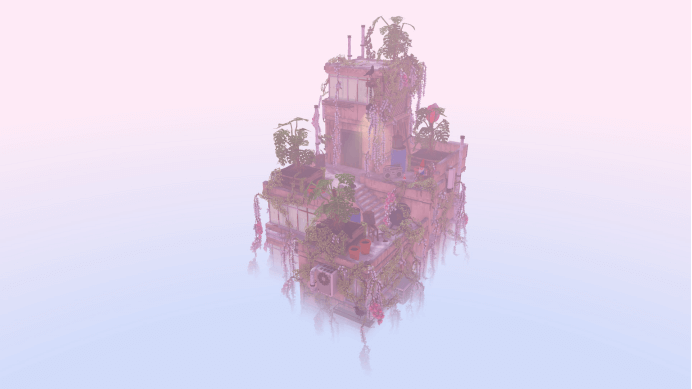
What moved me most was not the lush results in the end, but the “unfinished” moments in the middle. When the ivy has just crawled half of the broken window, when the wildflowers are still probing in the grooves of the old tires — at this moment, decay and rebirth have reached the most perfect balance. The skeleton of the ruins is still clear, reminding the past existence; and the gentle cover of the new life seems to be whispering the indiscriminate soothing power of time. I can’t help but take a screenshot, not to show what I have “completed”, but to collect the tension-filled tranquility that exists between destruction and growth. Here, aesthetics replaces utilitarianism, and the significance of the process far exceeds the result.
As the level advances, the types of ruins are also changing. From the accident site next to the rural highway, to the collapsed shopping mall in the city center, to some huge, strange, alien-like industrial complex. The behavior of plants is also fine-tuned. They spread faster on some surfaces and bloom more actively on other materials. This made me begin to subconsciously “read” the ruins: what does the deep scratch mean? What was the structure of that twisted shape? The game does not provide the answer, but it leads me to imagine and feel the silent, material-level dialogue between different materials and different life forms. What I repair is not a function, but a landscape, an emotion, and a form of memory that can rest in peace.
Later in the game, when I was familiar with the spleen of various plants, and the operation became almost as natural as breathing, a deep calm enveloped me. There is no enemy, no countdown, and no resource pressure. Only me, a silent ruin, and the network of life slowly unfolding under my fingertips. The background music is like a mist, sometimes an ethereal piano, and sometimes an ambient sound with subtle noise. This is not entertainment, but a kind of meditation.
After a long time of customs clearance, at dusk after the rain, I passed by a real abandoned construction site on the edge of the city full of weeds. My eyes no longer pass by, but stay. I saw the creeper wrapped around the rusty steel bar and the dandelion protruding from the mouth of the cement pipe. At that moment, _Cloud Gardens_ taught me to return to the perspective in an instant. It didn’t let me save the world in the game. It gave me a new pair of glasses. Through it, I look at all the places where human remains and natural recovery are intersected, which is full of an almost sacred tenderness. It makes me believe that perhaps the most profound repair is not to return everything to the way it was, but to learn to quietly embrace those irreparable scars in a plant way, and plant a little new, soft, time-related possibilities on it.