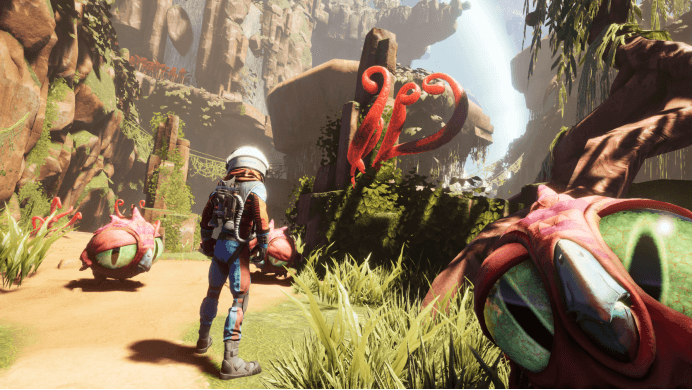
When I pressed the button of the planet’s soil analyzer for the first time, what I heard was not a technological “ticking” sound, but a series of light sound effects like the opening song of a cartoon. Then, the purple moss under my feet burped loudly and spewed out a cloud of spore clouds with rainbow luster. I was stunned, still holding the “Interstellar Exploration Glory Guide” issued by the company in my hand, and the alien world in front of me seemed to be jokingly inviting me, or mocking me. _Journey to the Savage Planet_ opened with such an absurd first impression — it made me play not a great pioneer of exploration, but more like an unlucky intern who was put into a strange backyard and had to pretend to be professional.
My employer, Kindred Aerospace, claims to be the “fourth best interstellar exploration enterprise in the universe”. From the handwritten “welcome” note in the landing cabin to the passionate but empty company propaganda broadcast from the headphones from time to time, a subtle sense of unreliability is everywhere. My mission sounds very serious: to assess whether the planet is suitable for human colonization. But it’s not like that at all when it’s implemented. The so-called “exploration” often turns into me taking pictures of a group of succulents that look like walking, or snatching a grumpy orange dung turtle’s beloved luminous dung ball. Every “scientific discovery” is recorded in the log, it will be accompanied by the overly enthusiastic electronic applause of the company’s system, as if I had just solved the ultimate mystery of the universe, instead of recording a farting mushroom. This huge contrast makes every solemn exploration slide into a nonsense farce.
However, under the laughter, something cold began to emerge. As I went deep into the planet, I found more traces of Kindred Aerospace — not the magnificent outpost, but abandoned cargo boxes, rusty probes, and some “environmental transformation” experimental remains that obviously ended in failure. On the edge of a cliff with magnificent scenery, I found the log recording of a former prospector. At first, his voice was full of professional optimism, but gradually, there was only his confusion about the beauty of the planet that could not be “conquered”, and the fatigue of the company’s endless data demand. The last recording is a long silence. In the background, there is only the strange, ethereal and lonely sound of the alien wind blowing through the cluster. The humorous sugar coating melts here, revealing the bitterness inside: the “civilization” we represent may be just an arrogant and clumsy child who leaves garbage and unfinished plans in the universe.
The most exquisite design of the game lies in how it gives me the “colonization” tools, but let these tools question me in turn. I am equipped with a scanner that can analyze all life, but the scan results never tell me why those creatures exist and what is related to them, except for the dry scientific classification. I built a transmission point to expand the “sphere of influence”, but this process requires a large amount of plundering of the planet’s natural resources, roughly stuffing those sparkling and beautiful crystals into the grinder, turning them into cold fuel numbers. The more efficiently I “develop” the planet, the quieter and monotonous it becomes. Until a certain moment, I stood in a valley that had become gray because of my excessive collection, listening to the company’s radio, which was still advocating “infinite progress”, and a strong feeling of nausea surged up. The technology in my hand did not make me understand the world better. It only made me exploit it more skillfully.
The ending of the game didn’t give me a grand triumph. After a brief contact with some ancient, huge existence in the depths of the planet that cannot be understood by human logic, what I got was not a clear answer, but the ultimate choice: to send the coordinates of the planet and all the “valuable” data back to the company in exchange for possible promotions and salary increases (and follow-up The destructive development of), or permanently delete it, so that this funny, fragile, beautiful and barbaric world can temporarily escape from the greedy gaze of human beings?
I chose the latter. At the moment of pressing the delete button, there was no tragic music, only my talkative and greedy AI partner, who was silent for a few seconds, and then said softly, “You know, I think you just did something... quite like the strange thing that the ‘fourth best’ employee would do.”
After quitting the game, the sense of absurdity did not disappear. _Journey to the Savage Planet_ has completed an extremely sharp deconstruction of the “anthropocentrism” adventure narrative with its colorful cartoon appearance and heartless jokes. It made my palms sweat while laughing. It reminds me that perhaps the most “savage” in the universe is never those burping moss or beetles throwing dung balls, but we interstellar visitors who break into other people’s homes with scanners and blueprints with smiles but never really stop to listen to what the wind is saying. After all, the real discovery may begin when we turn off the device and admit that we are not the only protagonist of the story.