The first time I saw the cub dying because of the label of “inbreeding: immunodeficiency”, my finger hung on the “end round” button and couldn’t press it for a long time. On the screen, the outline of its small pixel body gradually faded, and its parents — the elites I have carefully cultivated for more than a dozen generations and have perfect digging claws and thick fur — are standing aside blankly. At that moment, the blueprint of victory and the optimized gene sequence all solidified into a cold sense of guilt. _Niche_ tells me in the simplest way that natural selection is never a multiple-choice question, but a long journey in a random storm, grasping blood and survival.
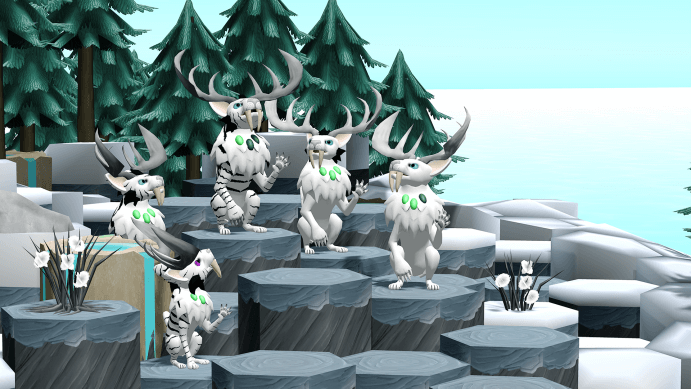
My ethnic group began in a lush but dangerous meadow. Five “Niche beasts” of different appearances — a bit like a fox and a bit like a weasel — are all my blood. The game has no epic goal, only survival and letting the bloodline continue. And my tool is a clear and almost cruel genetic panel. The appearance, ability, and even disease risk of each animal are determined by dominant and recessive genetic cards. The long nose is conducive to digging the rhizome, the short hair adapts to the heat, and the blue fur can be hidden in the jungle... But behind the beautiful qualities, there may be the shadow of anemia or the fragile heart. I am like an apprehensive creator, carefully calculating the pairing of each pair of partners, trying to walk a tightrope between current survival and long-term gene pool health. However, the rule of “genetic drift”, which cannot be closed, will always mess up my carefully designed blueprint at the most unexpected time.
The most profound narrative of the game is hidden in these “accidents”. A cub with a “curiosity” gene that I was not optimistic about accidentally found a hidden berry bush during an exploration, saving the population on the verge of famine. An individual who was too conspicuous due to the mutation of hair color got a blessing from disaster. When the predator attacked, he became a bait to attract firepower and bought time for the escape of other members of the family. Those “defects” from the perspective of pure optimization may be transformed into the key to redemption in the dynamic, cruel and accidental natural script. I gradually learned that I no longer just pursue the “strongest” genes, but also pursue the “most tough” diversity. A thick-skinned gene that can cope with the dry season may be useless when the plague strikes; while a seemingly useless “strong social” trait may avoid the deadly predator territory through information sharing between ethnic groups. Survival is not static perfection, but dynamic adaptation and redundancy.
With the change of generations, my ethnic group has migrated through the swamps and trekked through the snowfields, and the gene bank has quietly changed in choices and accidents. I will mourn for the “grandmothers” who accompanied the ethnic group for dozens of rounds and finally died due to old age or accident — their genetic fragments have been scattered among future generations, and their names are remembered in the form of “ancestors”. Every area that has been explored and left on the map is like a page on the genealogy, recording who was alive, who made sacrifices, and who brought the key mutations at that time. History is not written in words, but engraved in the DNA sequence of each existing Niche beast, which is silently told by fur color, body size and special ability.
The challenge of the game does not come from the powerful boss from the outside, but from the gradual accumulation of internal genetic load, or a sudden and unpredictable plague or climate change from the outside. Once, almost all of my ethnic group suffered from respiratory diseases due to a series of unfortunate genetic combinations. Watching them weaken one by one, the choices I can do are extremely limited: isolate patients? That means giving up some family members. Adventure through the toxic spore area to find antidote plants? Maybe the whole army will be destroyed. At that moment, what I faced was not the solution of the advantages and disadvantages of strategy games, but the heavy and real ethical dilemma of life itself. I chose to take risks and lost one-third of the members, but I found the medicine, and the bloodline was continued. There was no cheering, only the silence of the rest of the life after the robbery, and a heavy memory of the deceased name.
When my group finally reached the legendary safe habitat with a rich and stable gene pool, I did not feel the joy of conquest. I widened my perspective and watched those pixel dots multiply in the fertile land. They carried the adaptability of the swamp, the thick hair of the snowfield, the water-saving ability of the dry land, and the heritage of countless individuals who died or survived in the crisis. They are a walking and living memory bank.
Close the game, and the awe of “life” lasts for a long time. _Niche_ strips away all romantic imaginations and reduces the evolution into a probability-based, harsh and magnificent protracted war. It made me touch the real temperature of the word “suitable” in “survival of the fittest” — it is not the one-man show of the strongest, but a tough and diverse net woven by the whole race with countless individual attempts, mistakes, sacrifices and luck in the long river of time. We all sail in our own genetic drift, and the real wisdom of survival may lie in learning to cherish those seemingly imperfect mutations and understanding that in the story of life, continuation itself is the greatest victory.