The first time I pressed the recording button, it was at an old ginkgo tree with golden leaves that was silent in the wind. The rustling sound of the wind blowing through the leaves, the fine sound of wheels running over the gravel road, and my own breathing — these ordinary sounds were captured by the microphone and condensed into a 30-second audio file, which were archived in my increasingly thick “log”. There is no experience value pop-up, no task update, only a strange sense of fulfillment, as if I carefully scooped up a ladle of water that was about to evaporate from the river of time. _Season: A Letter to the Future_ gave me not a weapon or tool, but a bicycle, a recorder, a camera and a blank sketchbook. My mission is not to change the end, but to write a gentle postscript for a known and peaceful ending.
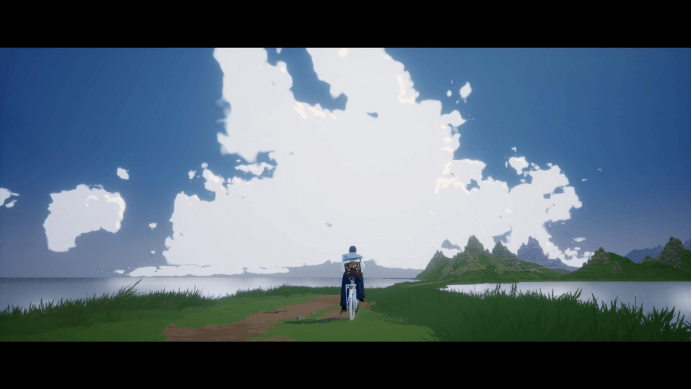
I got into the car and left the valley that sheltered me and was about to sink forever. The world is not a wasteland, but an abandoned and amazing abundance. Civilization did not collapse, it just stopped quietly at some point. The village was empty, but there was still half a glass of water on the table; only half of the formula on the school blackboard was derived; the shirt on the clothesline swayed gently in the wind, as if the owner was just out for a walk. This “sudden silence” is more trembling than any ruins. My job is not to interpret why this disaster called “season” happened, but to record “how” it exists — to collect the texture of life that is about to be erased.
The core gameplay of the game is an almost poetic “field survey”. I rode on the picturesque mountain road and was suddenly attracted by a strange aroma. Stop the car and follow the smell to find a rose garden hidden behind the ruins and still in full bloom. I can take pictures of its backlight figure with the camera, record the subtle sound of the bees’ buzzing and the fluttering of petals with the recorder, and I can also open the sketchbook and spend a few minutes sketching its posture wrapped around the rusty iron door. Each recording method leaves “traces” of different natures in my log: photos provide visual evidence, recordings preserve the atmosphere, and sketches capture the emotional focus under my personal gaze. These collectibles are not isolated loots. They will automatically link and annotate each other in the log, and gradually collage three-dimensional memories of a place, a person or a custom.
What touches me most is those moments when I need to take the initiative to “interpret” and “connect”. At an abandoned bus stop, I found a postcard soaked in rain with blurred handwriting. By enlarging the details of the camera, I can identify several phrases: “Miss you”, “The soup is warm”, “Spring is back”. Not far away, I recorded a sporadic note of a broken wind chime hanging under the eaves. On the wall behind the signboard, I completed a sketch of a child’s tender graffiti — an adult holding a child’s hand. I sat quietly and put these fragments together in my mind. There is no standard answer, but a story about parting, waiting and small hope naturally emerges in my mind. I’m not in archaeology. I’m using the fragments left by strangers to carry out a literary creation full of sympatheticity.
As the journey deepened, I met a few “last-generation residents” who were still alive. They are not heroes waiting to be saved, but ordinary people who calmly take care of the last daily life before the end. An old potter was still working by the kiln. She said that she wanted to burn the last batch of clay, “so that they would not feel abandoned halfway.” I took photos of her pottery, recorded the creaking of the wheel, and drew her focused side face. She gave me a small piece of pottery baked into ginkgo leaves, which became a “physical” collection in my logbook, with the temperature of dirt. In these interactions, I was never asked to change their fate. My role is a dedicated listener and witness. My very existence — willing to stop and spend time recording their stories — seems to be the highest tribute to their calm dignity at the end of history.
The game does not provide a complete map. My route is decided by myself, and the world will generate a unique “memory map” in the log based on the memory fragments I collect. The direction of the river may be marked with a danger symbol because I recorded a legend about the flood; a hidden path may be lit up on the map because I found a stone carving of vows hidden by a pair of lovers. The map I created is not in the geographical sense, but at the emotional and memory level. It is only meaningful to me. It is the completely private network I have established with this fading world.
Finally, I reached the end of the journey — a high cliff overlooking the valley of my hometown. The game didn’t let me make any major choices that affect the world. It only asks me: Are you ready to seal your log and put it into the “time capsule” to the future? I looked through my thick log, which was full of photos, sketches and audio marks. There were no heroic epics in it, only the shape of the wind, the spots of light, the unfinished words and the unfinished pottery. I chose to seal it.
Quit the game, and there is a noisy and endless world outside the window. But my senses seem to be calibrated by the game. _Season_ did not give me the pride of saving the world. It gave me a new perception model: it taught me to let go of the powerless anxiety and pick up the piety of the recorder in the face of things that are destined to fade away. It makes me believe that the most powerful way to fight against forgetfulness may not be to build a monument, but to ride a bicycle, bring the simplest tools, and gently and seriously tell the future: “Look, there was such a gust of wind, there was such a ray of light, and someone lived like this.” Because the ultimate dignity of civilization may be contained in the sound of a ginkgo leaf falling, which seems insignificant but is solemnly collected by people with intentions.